
Below You will find some of my presentations, classes and interviews as audio or video. I hope You will find them interesting.
Video
Audio
Bhagavata Purana Documentary
What is it about this text that makes it so interesting to study and also to live for so many people not just in India but more and more all over the world?
We are going to be exploring, meeting people, finding out more about this tradition which I’ve been studying for the last forty years. My own quest is to get a better sense of why is it that this text – the Bhagavata Purana – is popular, is interesting for scholars, but for all kind of people after so many centuries.
Dr Kenneth Valpey
New Book Brings Cow Care Into Serious Discussion in Academia and Beyond
By: Madhava Smullen for ISKCON News on June 13, 2019
Cow Care in Hindu Animal Ethics, a new book by ISKCON guru and scholar Krishna Kshetra Swami, will be published by Palgrave Macmillan in early 2020. The work is set to make caring for cows, in the spirit of devotion, a serious topic of discussion in academia worldwide.
Cow Care in Hindu Animal Ethics speaks exclusively and in great detail to educated, thoughtful readers about the immense value and special practices involved in caring for cows, both devotionally and professionally, from the viewpoint of Hindu thought and practice.
The prestigious publisher, Palgrave Macmillan, publishes award-winning research which changes the world across the humanities, social sciences and business for academics, professionals and librarians.
Andrew Linzey, editor of the publisher’s “Animal Ethics” book series (which features some of the most brilliant thinkers on the subject), personally invited Krishna Kshetra Swami to write the monograph on animal ethics in Hinduism.
The connection came about because Krishna Kshetra Swami (Dr. Kenneth Valpey) has been a Research Fellow for the Oxford Centre for Animal Ethics since 2015, for which Linzey also serves as director.
I address the fact that India has one of the largest dairy industries in the world as of the 1970s, and that this is driving the meat industry there more than anything else…
“[Prof. Linzey] asked me several times, and initially I wasn’t jumping on the idea,” Swami says. “But when he said he wanted me to write it specifically because I was a practitioner for over 45 years, I started to think, maybe Krishna wants me to do this.”
Because of the predominance of concern for cows in Hindu and Vaishnava traditions, Krishna Kshetra Swami decided to focus on cow care. His book has five chapters: the first gives a literary overview on cows and cow care, from the Rig Veda, through the Srimad-Bhagavatam, to pre-modern bhakti literature and 20th century Hindi articles, showing that cows have been considered important through the ages.
“There’s a scholarly notion today that the sacred cow is a very modern idea in Hinduism,” he explains.
The second chapter introduces four key characters in the modern cow protection movement, which began in the late 19th century. These are Dayananda Sarasvati, who wrote a very influential pamphlet on the subject in 1882; Mahatma Gandhi; B.R. Ambedkar, a founding father of independent India who disagreed with Gandhi (as a countervoice to the Hindu perspective); and ISKCON Founder-Acharya Srila Prabhupada.
“I specifically call attention to the fact that Srila Prabhupada called for cow protection worldwide, rather than only in India,” Krishna Kshetra Swami says. “Quite radically he also disconnected cow care from Hinduism. And to my knowledge, he never made a value distinction between Indian indigenous cow breeds and the Western bos Taurus varieties, which most Hindutva champions of cow protection do.”
In the second chapter, Krishna Kshetra Swami also discusses the controversial issue of whether animal sacrifices were performed in ancient times, following Vedic injunctions; as well as the later predominance of the ethics of ahimsa.
In chapter three, he covers the present day situation regarding cows in India. To research this chapter, he spent time in India, visiting goshalas, and interviewing goshala managers, cow protectors and activists.
“I address the fact that India has one of the largest dairy industries in the world as of the 1970s, and that this is driving the meat industry there more than anything else,” he says. “The fact is that India has a large industry of cow slaughter and meat, and especially export of leather. I also address the volatile political situation in India around cow slaughter and activism against it.”
Chapter four tackles the topic from a philosophical angle, introducing the notions of dharma, yoga, and bhakti in the context of animal ethics. Drawing from the Srimad-Bhagavatam, Krishna Kshetra Swami tells the story of Bharata, a yogi who becomes attached to a deer, then becomes a deer himself; and weaves this into a discussion on Western animal ethic theory.
He also discusses veganism, and whether we should stop drinking cows’ milk altogether, or focus instead on having a caring rather than exploitative relationship with cows.
Finally, the fifth chapter looks at the future of cow care. Here, Krishna Kshetra Swami introduces two ISKCON cow protection projects – Mayapur in India, and New Vrajadhama in Hungary. Acknowledging the number of cows they care for as extremely small compared to how many cows are killed, he nevertheless says that these and other similar projects provide a model for how cow care can be done. He also emphasizes the importance of not just caring for cows, but of the whole devotional way of life around it, in which cows are seen as family members.
The book concludes with six “affirmations” of cow care, which imagine a possible reality in present tense positive statements, as if it is actually happening. These are tethered to the six “moral foundations of political life” discussed by social psychologist Professor Jonathan Haidt.
In summarized form, these affirmations are: 1) Cow Care and Care – We care for cows throughout their natural lives as subjects, rather than as objects.
2) Cow Care and Fairness – We ensure that byproducts of the cow such as milk are obtained only under strict conditions of respectful and caring treatment.
3) Cow Care and Liberty – We honor that people have a choice in their diet, while explaining the reasons for reducing meat consumption, including the environmental cost.
4) Cow Care and Loyalty – The locus of our loyalty is not based on communalism (which in India contributes to conflicts around cow protection) but on knowledge in the mode of goodness, which, according to the Bhagavad-gita, reveals a single unchanging reality in all beings.
5) Cow Care and Authority – We put our trust in authorities who have experience and knowledge in caring for cows, not just in politicians or other persons in positions of power.
6) Cow Care and Sanctity – We consider cows as bearing sanctity, but not to the exclusion of other animals.
When it is published in January or February next year, Cow Care in Hindu Animal Ethics will be used as a reference book in a variety of areas of academic concern, such as philosophy, cultural studies, anthropology, South Asian studies, and more.
However since the hardcopy edition will be expensive and reach only a limited number of academic readers, Krishna Kshetra Swami also wants to go beyond those confines and use Palgrave Macmillan’s Open Access option to reach a broader readership of thoughtful, educated people.
He is currently raising $17,000 to cover the cost of this option, which will make the book available as a completely free, legal e-book download, available at the publisher’s website right after the hardcopy is published, so that it can be read by anyone.
“I hope that the book will bring the whole subject more into conversation, as a serious topic,” he says. “Currently the term ‘holy cow,’ is used in English as an exclamation, something of a joke. I want to suggest, let’s think about actual cows. Let’s think about the fact that there are 300 million cows being slaughtered annually. That comes to 34,000 cows per hour. And let’s ask ourselves, do we really need this? Do we need to drink all that milk?”
To help create an Open Access option so that Cow Care in Hindu Animal Ethics can be read widely for free, please visit: https://www.gofundme.com/cow-care-book To find out more about the benefits of Open Access Publishing, visit: https://www.palgrave.com/gp/rights-permissions/open/benefits
High time I learn how to milk a cow
November 17, 2019
Radhadesh, Belgium
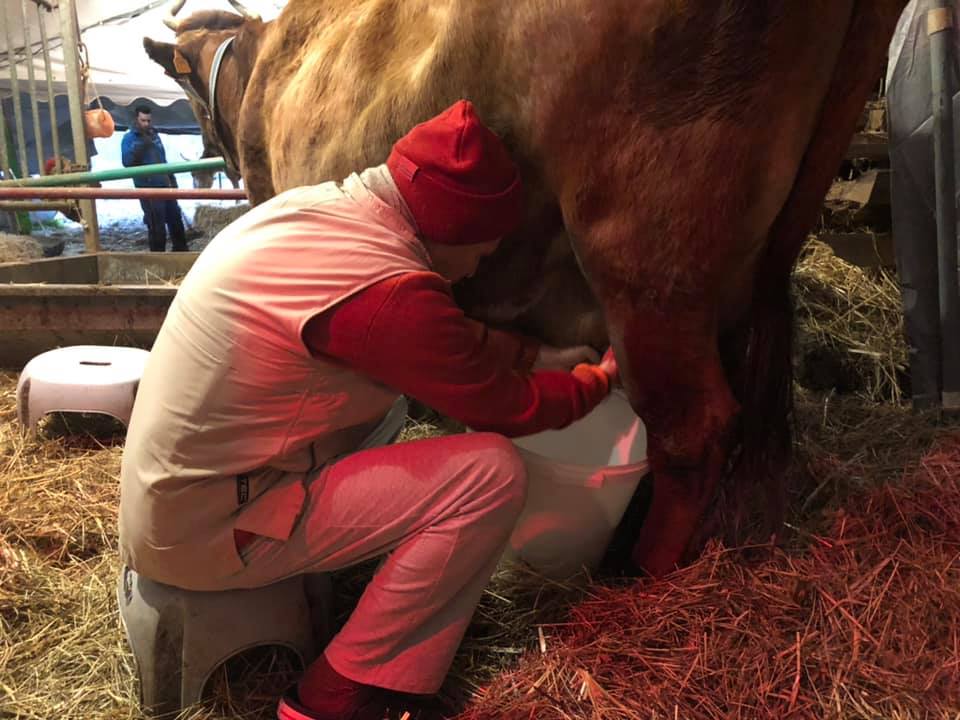
After writing a book about cows, it’s high time I learn how to MILK a cow. Not as easy as it looks, as I found with Bhumi, here at Radhadesh in Belgium. Fortunately she was patient with me.
Bhagavata Purana Documentary
/in Bhagavata Purana, VideoWhat is it about this text that makes it so interesting to study and also to live for so many people not just in India but more and more all over the world?
New Book Brings Cow Care Into Serious Discussion in Academia and Beyond
/in Cow care project, PressBy: Madhava Smullen for ISKCON News on June 13, 2019
Cow Care in Hindu Animal Ethics, a new book by ISKCON guru and scholar Krishna Kshetra Swami, will be published by Palgrave Macmillan in early 2020. The work is set to make caring for cows, in the spirit of devotion, a serious topic of discussion in academia worldwide.
Cow Care in Hindu Animal Ethics speaks exclusively and in great detail to educated, thoughtful readers about the immense value and special practices involved in caring for cows, both devotionally and professionally, from the viewpoint of Hindu thought and practice.
The prestigious publisher, Palgrave Macmillan, publishes award-winning research which changes the world across the humanities, social sciences and business for academics, professionals and librarians.
Andrew Linzey, editor of the publisher’s “Animal Ethics” book series (which features some of the most brilliant thinkers on the subject), personally invited Krishna Kshetra Swami to write the monograph on animal ethics in Hinduism.
The connection came about because Krishna Kshetra Swami (Dr. Kenneth Valpey) has been a Research Fellow for the Oxford Centre for Animal Ethics since 2015, for which Linzey also serves as director.
“[Prof. Linzey] asked me several times, and initially I wasn’t jumping on the idea,” Swami says. “But when he said he wanted me to write it specifically because I was a practitioner for over 45 years, I started to think, maybe Krishna wants me to do this.”
Because of the predominance of concern for cows in Hindu and Vaishnava traditions, Krishna Kshetra Swami decided to focus on cow care. His book has five chapters: the first gives a literary overview on cows and cow care, from the Rig Veda, through the Srimad-Bhagavatam, to pre-modern bhakti literature and 20th century Hindi articles, showing that cows have been considered important through the ages.
“There’s a scholarly notion today that the sacred cow is a very modern idea in Hinduism,” he explains.
The second chapter introduces four key characters in the modern cow protection movement, which began in the late 19th century. These are Dayananda Sarasvati, who wrote a very influential pamphlet on the subject in 1882; Mahatma Gandhi; B.R. Ambedkar, a founding father of independent India who disagreed with Gandhi (as a countervoice to the Hindu perspective); and ISKCON Founder-Acharya Srila Prabhupada.
“I specifically call attention to the fact that Srila Prabhupada called for cow protection worldwide, rather than only in India,” Krishna Kshetra Swami says. “Quite radically he also disconnected cow care from Hinduism. And to my knowledge, he never made a value distinction between Indian indigenous cow breeds and the Western bos Taurus varieties, which most Hindutva champions of cow protection do.”
In the second chapter, Krishna Kshetra Swami also discusses the controversial issue of whether animal sacrifices were performed in ancient times, following Vedic injunctions; as well as the later predominance of the ethics of ahimsa.
In chapter three, he covers the present day situation regarding cows in India. To research this chapter, he spent time in India, visiting goshalas, and interviewing goshala managers, cow protectors and activists.
“I address the fact that India has one of the largest dairy industries in the world as of the 1970s, and that this is driving the meat industry there more than anything else,” he says. “The fact is that India has a large industry of cow slaughter and meat, and especially export of leather. I also address the volatile political situation in India around cow slaughter and activism against it.”
Chapter four tackles the topic from a philosophical angle, introducing the notions of dharma, yoga, and bhakti in the context of animal ethics. Drawing from the Srimad-Bhagavatam, Krishna Kshetra Swami tells the story of Bharata, a yogi who becomes attached to a deer, then becomes a deer himself; and weaves this into a discussion on Western animal ethic theory.
He also discusses veganism, and whether we should stop drinking cows’ milk altogether, or focus instead on having a caring rather than exploitative relationship with cows.
Finally, the fifth chapter looks at the future of cow care. Here, Krishna Kshetra Swami introduces two ISKCON cow protection projects – Mayapur in India, and New Vrajadhama in Hungary. Acknowledging the number of cows they care for as extremely small compared to how many cows are killed, he nevertheless says that these and other similar projects provide a model for how cow care can be done. He also emphasizes the importance of not just caring for cows, but of the whole devotional way of life around it, in which cows are seen as family members.
The book concludes with six “affirmations” of cow care, which imagine a possible reality in present tense positive statements, as if it is actually happening. These are tethered to the six “moral foundations of political life” discussed by social psychologist Professor Jonathan Haidt.
In summarized form, these affirmations are: 1) Cow Care and Care – We care for cows throughout their natural lives as subjects, rather than as objects.
2) Cow Care and Fairness – We ensure that byproducts of the cow such as milk are obtained only under strict conditions of respectful and caring treatment.
3) Cow Care and Liberty – We honor that people have a choice in their diet, while explaining the reasons for reducing meat consumption, including the environmental cost.
4) Cow Care and Loyalty – The locus of our loyalty is not based on communalism (which in India contributes to conflicts around cow protection) but on knowledge in the mode of goodness, which, according to the Bhagavad-gita, reveals a single unchanging reality in all beings.
5) Cow Care and Authority – We put our trust in authorities who have experience and knowledge in caring for cows, not just in politicians or other persons in positions of power.
6) Cow Care and Sanctity – We consider cows as bearing sanctity, but not to the exclusion of other animals.
When it is published in January or February next year, Cow Care in Hindu Animal Ethics will be used as a reference book in a variety of areas of academic concern, such as philosophy, cultural studies, anthropology, South Asian studies, and more.
However since the hardcopy edition will be expensive and reach only a limited number of academic readers, Krishna Kshetra Swami also wants to go beyond those confines and use Palgrave Macmillan’s Open Access option to reach a broader readership of thoughtful, educated people.
He is currently raising $17,000 to cover the cost of this option, which will make the book available as a completely free, legal e-book download, available at the publisher’s website right after the hardcopy is published, so that it can be read by anyone.
“I hope that the book will bring the whole subject more into conversation, as a serious topic,” he says. “Currently the term ‘holy cow,’ is used in English as an exclamation, something of a joke. I want to suggest, let’s think about actual cows. Let’s think about the fact that there are 300 million cows being slaughtered annually. That comes to 34,000 cows per hour. And let’s ask ourselves, do we really need this? Do we need to drink all that milk?”
To help create an Open Access option so that Cow Care in Hindu Animal Ethics can be read widely for free, please visit: https://www.gofundme.com/cow-care-book To find out more about the benefits of Open Access Publishing, visit: https://www.palgrave.com/gp/rights-permissions/open/benefits
High time I learn how to milk a cow
/in Cow care projectNovember 17, 2019
Radhadesh, Belgium
After writing a book about cows, it’s high time I learn how to MILK a cow. Not as easy as it looks, as I found with Bhumi, here at Radhadesh in Belgium. Fortunately she was patient with me.