
Below You will find some of my presentations, classes and interviews as audio or video. I hope You will find them interesting.
Video
Audio
Pioneering Book on Cow Care in India
OXFORD, UK, February 6, 2020 by: EINPresswire.com
Dr Keneth Valpey publishes a pioneering book on the history, philosophy, and ethical status of the cow in India.This is a path-breaking book that deserves to be widely read … Original and thought-provoking, this book will open up new venues for discussion and reflection regarding cow care.”— Mary Evelyn Tucker, Yale University, USA
Factory farming – specifically the beef industry – is considered one of the main contributors to climate change, prompting many activists and conscientious citizens to rethink their consumption of beef and dairy entirely. But what if there was a more considerate way to interact with cows – one that met the needs of both humans and the planet? Kenneth Valpey’s Cow Care in Hindu Animal Ethics examines how the welfare of human civilization is inextricably linked to the care and protection of the cow.
The book begins with a fascinating journey through India’s oldest texts in search of early references to the cow and its relation to human society – from the Rigveda to the Bhagavata Purana to medieval bhakti poetry. From there, Valpey reviews ideas of prominent modern Indian thinkers, providing a penetrating glimpse into the country’s current cow care practices.
In the book’s most philosophical chapter, Valpey proposes an animal ethic that combines Western ethics-of-care and environmental thinking with India’s traditions of: dharma (the sense of duty toward all living beings), yoga (the fostering of virtues such as non-violence, culminating in liberation), and bhakti (the channelling of one’s devotion toward the supreme, leading to a deep sense of relationality with all creatures).
Drawing upon a rich blend of cultural studies, intellectual history, and original fieldwork, Valpey suggests the need for practical action to develop models of sustainable cow care communities – action energized by knowledge, inspiration, and the vision of a future society in which cows are protected, not slain.
“This is a path-breaking book that deserves to be widely read. Valpey expands our understanding of animal ethics and complexifies our notion of devotion. Original and thought-provoking, this book will open up new venues for discussion and reflection regarding cow care.”
—Mary Evelyn Tucker, Yale Forum on Religion and Ecology, Yale University, USA
Dr Kenneth R. Valpey is a research fellow of the Oxford Centre for Hindu Studies and a fellow of the Oxford Centre for Animal Ethics, UK. Besides Hindu animal ethics, he has published on Vaishnava Hindu temple worship traditions and on India’s enduring favourite of bhakti literature, the Bhāgavata Purāṇa.
To purchase a hard copy or download the book for free through Open Access, see here. Also available at other online book outlets.
Contact: Divya Alter, +1 313-909-2800
Contact@kennthvalpey.com
Series: The Palgrave Macmillan Animal Ethics Series
Src: https://www.einnews.com/pr_news/509071305/pioneering-book-on-cow-care-in-india
Ten Days of Jainism
Dec. 27 2019 to Jan. 7 2020, India
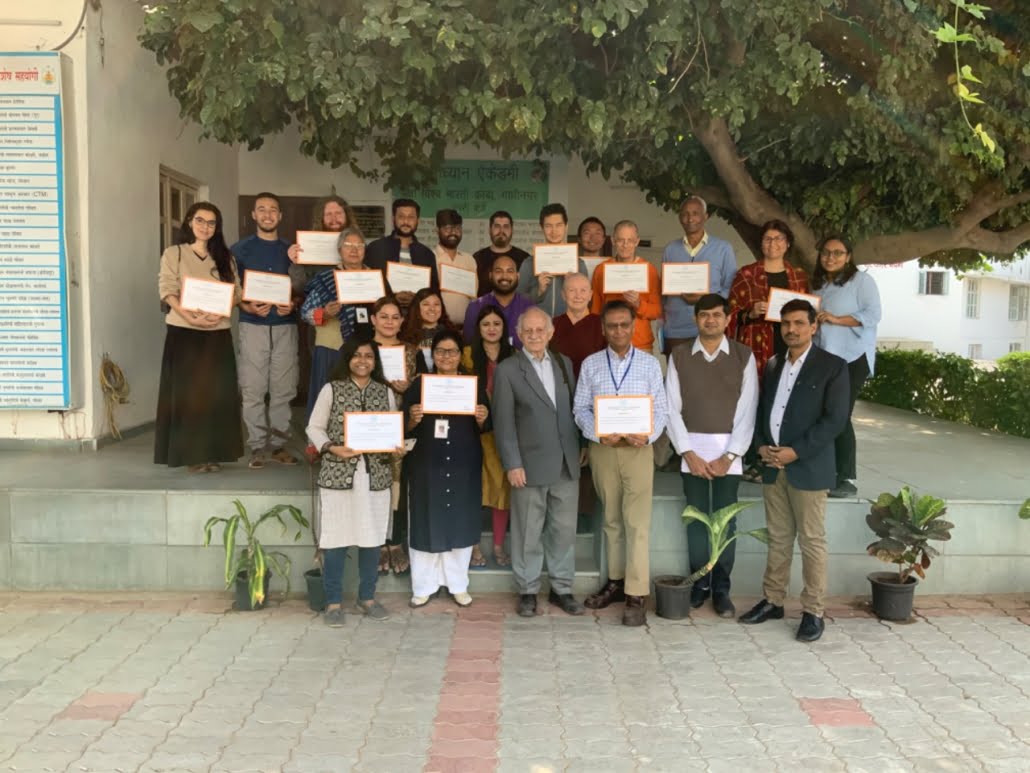
The International School of Jain Studies offers a ten-day (Dec. 27 to Jan. 7) introduction to Jainism each December-January for university students, especially those engaged in the academic study of religion. Jainism is a very ancient tradition, at least as old as Buddhism, with a rich literary canon and highly developed philosophy, centered around the principle of ahiṁsā—“nonviolence”. We were 23 students altogether, from several countries and varied backgrounds, including some undergraduates, some post-graduates, and some doctoral candidates doing research specifically on Jainism. The ahiṁsā ethic, so central to Jainism, was of particular interest to me, as I had been thinking and writing about this theme for the Cow Care book. A related interest was simply to learn “first-hand” about this lesser-known tradition to broaden my horizon of religious life, in pursuit of my interest in interreligious dialogue.
As explained by our main instructor, Dr. Shugan Jain, in India religious traditions are typically categorized as either astika or nāstika—based on whether the Veda is accepted as authoritative scripture or not. Jains are labeled as nāstika, along with Buddhists and other lesser known (or no longer existing) traditions, as they are seen as rejecting the Vedas. Also, the same line of demarcation is made between “brahmanical” and “shramanical” traditions, with Jainism and Buddhism falling in the latter category. Hindus, on the other hand, are typically labeled as astika and brahmanical, due to their regard for the existing Vedic literature.
But I suggest a different way of looking at this, considering that there are so many features shared across traditions, between brahmanical and shramanical ways. My idea is that if we take “Veda” in its broad sense as meaning “knowledge”, and if we recall that Jiva Goswami, the 16th century theologian of the Chaitanya Vaishnava tradition, says that only a fraction of the totality of Vedic literature is currently available, we can picture Veda as the ocean of spiritual knowledge from which all current religious traditions have drawn their inspiration. This way of thinking could serve to bring greater appreciation (greater wonder) among the different religious traditions, possibly lessoning the distance and antagonism among each other.And speaking of interreligious dialogue in relation to Jainism, an intriguing and rather central philosophical concept in Jainism is anekānta-vāda—the idea that truth is never comprehended in its totality by any one person. Also intriguing is that this idea gets juxtaposed with the notion that the Tirthankaras—the personages who are understood to have attained perfection, eternal liberation—are understood to be omniscient, all-knowing. Much of what makes religion so fascinating is the paradoxical nature of religious or theological claims (and religious practices).
The Cow Care Book on New Books Network
By: Raj Balkaran for New Books Network on January 16, 2020
What does cow care in India have to offer modern Western discourse animal ethics? Why are cows treated with such reverence in the Indian context? Join us as we speak to Kenneth R. Valpey about his new book Cow Care in Hindu Animal Ethics (Palgrave Macmillan, 2019). Valpey discusses his methodological odyssey looking at ancient Hindu scriptural accounts of cows, to modern Hindu thinkers (Gandhi, Ambedkar) on cow protection, to ethnographic work on individuals engaged in the modern Indian cow protection movement.
Raj Balkaran
Listen to the podcast on:
Pioneering Book on Cow Care in India
/in Cow care project, PressOXFORD, UK, February 6, 2020 by: EINPresswire.com
Dr Keneth Valpey publishes a pioneering book on the history, philosophy, and ethical status of the cow in India.This is a path-breaking book that deserves to be widely read … Original and thought-provoking, this book will open up new venues for discussion and reflection regarding cow care.”— Mary Evelyn Tucker, Yale University, USA
Factory farming – specifically the beef industry – is considered one of the main contributors to climate change, prompting many activists and conscientious citizens to rethink their consumption of beef and dairy entirely. But what if there was a more considerate way to interact with cows – one that met the needs of both humans and the planet? Kenneth Valpey’s Cow Care in Hindu Animal Ethics examines how the welfare of human civilization is inextricably linked to the care and protection of the cow.
The book begins with a fascinating journey through India’s oldest texts in search of early references to the cow and its relation to human society – from the Rigveda to the Bhagavata Purana to medieval bhakti poetry. From there, Valpey reviews ideas of prominent modern Indian thinkers, providing a penetrating glimpse into the country’s current cow care practices.
In the book’s most philosophical chapter, Valpey proposes an animal ethic that combines Western ethics-of-care and environmental thinking with India’s traditions of: dharma (the sense of duty toward all living beings), yoga (the fostering of virtues such as non-violence, culminating in liberation), and bhakti (the channelling of one’s devotion toward the supreme, leading to a deep sense of relationality with all creatures).
Drawing upon a rich blend of cultural studies, intellectual history, and original fieldwork, Valpey suggests the need for practical action to develop models of sustainable cow care communities – action energized by knowledge, inspiration, and the vision of a future society in which cows are protected, not slain.
Dr Kenneth R. Valpey is a research fellow of the Oxford Centre for Hindu Studies and a fellow of the Oxford Centre for Animal Ethics, UK. Besides Hindu animal ethics, he has published on Vaishnava Hindu temple worship traditions and on India’s enduring favourite of bhakti literature, the Bhāgavata Purāṇa.
To purchase a hard copy or download the book for free through Open Access, see here. Also available at other online book outlets.
Contact: Divya Alter, +1 313-909-2800
Contact@kennthvalpey.com
Series: The Palgrave Macmillan Animal Ethics Series
Src: https://www.einnews.com/pr_news/509071305/pioneering-book-on-cow-care-in-india
Ten Days of Jainism
/in Bhagavata PuranaDec. 27 2019 to Jan. 7 2020, India
The International School of Jain Studies offers a ten-day (Dec. 27 to Jan. 7) introduction to Jainism each December-January for university students, especially those engaged in the academic study of religion. Jainism is a very ancient tradition, at least as old as Buddhism, with a rich literary canon and highly developed philosophy, centered around the principle of ahiṁsā—“nonviolence”. We were 23 students altogether, from several countries and varied backgrounds, including some undergraduates, some post-graduates, and some doctoral candidates doing research specifically on Jainism. The ahiṁsā ethic, so central to Jainism, was of particular interest to me, as I had been thinking and writing about this theme for the Cow Care book. A related interest was simply to learn “first-hand” about this lesser-known tradition to broaden my horizon of religious life, in pursuit of my interest in interreligious dialogue.
As explained by our main instructor, Dr. Shugan Jain, in India religious traditions are typically categorized as either astika or nāstika—based on whether the Veda is accepted as authoritative scripture or not. Jains are labeled as nāstika, along with Buddhists and other lesser known (or no longer existing) traditions, as they are seen as rejecting the Vedas. Also, the same line of demarcation is made between “brahmanical” and “shramanical” traditions, with Jainism and Buddhism falling in the latter category. Hindus, on the other hand, are typically labeled as astika and brahmanical, due to their regard for the existing Vedic literature.
But I suggest a different way of looking at this, considering that there are so many features shared across traditions, between brahmanical and shramanical ways. My idea is that if we take “Veda” in its broad sense as meaning “knowledge”, and if we recall that Jiva Goswami, the 16th century theologian of the Chaitanya Vaishnava tradition, says that only a fraction of the totality of Vedic literature is currently available, we can picture Veda as the ocean of spiritual knowledge from which all current religious traditions have drawn their inspiration. This way of thinking could serve to bring greater appreciation (greater wonder) among the different religious traditions, possibly lessoning the distance and antagonism among each other.And speaking of interreligious dialogue in relation to Jainism, an intriguing and rather central philosophical concept in Jainism is anekānta-vāda—the idea that truth is never comprehended in its totality by any one person. Also intriguing is that this idea gets juxtaposed with the notion that the Tirthankaras—the personages who are understood to have attained perfection, eternal liberation—are understood to be omniscient, all-knowing. Much of what makes religion so fascinating is the paradoxical nature of religious or theological claims (and religious practices).
The Cow Care Book on New Books Network
/in Cow care project, PressBy: Raj Balkaran for New Books Network on January 16, 2020
Listen to the podcast on:
https://newbooksnetwork.com/kenneth-r-valpey-cow-care-in-hindu-animal-ethics-palgrave-macmillan-2019/